
Article
How SBA’s New Quality of Earnings Requirement Will Impact Acquisition Lending
By Scott Danger, CPA, CVA and Adam Wolf, CVA
Beginning October 1, 2026, a Quality of Earnings (QoE) analysis will become a required component of many SBA 7(a) change-of-ownership transactions.
While the change may appear procedural, its implications are significant. For the first time, many SBA-financed acquisitions will require an independent review of earnings before financing can be finalized. For buyers, sellers, lenders, and advisors, the key takeaway is that reported earnings must withstand independent scrutiny.
Why the Change Matters
Historically, acquisition loans were often underwritten using tax returns, financial statements, and valuation reports without a separate analysis focused specifically on earnings quality. SBA SOP 50 10 8.1 changes that approach. Beginning October 1, 2026, lenders must obtain a QoE report for certain initial acquisition transactions and business expansion acquisitions.
The requirement generally applies to many complete change-of-ownership transactions with a purchase price of $3 million or greater, subject to the specific requirements and exceptions contained in SBA SOP 50 10 8.1. However, owner buyouts, ESOP transactions, and cooperative transactions are generally exempt.
Perhaps most importantly, lenders must use the earnings established through the QoE process when calculating debt service coverage. If normalized earnings are lower than originally reported, the amount of debt the business can support may also decrease. In some cases, buyers may need to contribute additional equity, revise transaction terms, or adjust the financing structure.
As a result, the QoE is moving from a recommended diligence tool to a critical part of the underwriting process.
Why the Requirement Matters to Lenders
In an acquisition, buyers are often financing more than equipment, inventory, and other tangible assets. Generally, a meaningful portion of the purchase price is supported by expected future earnings. When earnings are overstated, the impact extends beyond valuation. It can affect debt service coverage, loan sizing, and ultimately a lender’s ability to underwrite the transaction confidently.
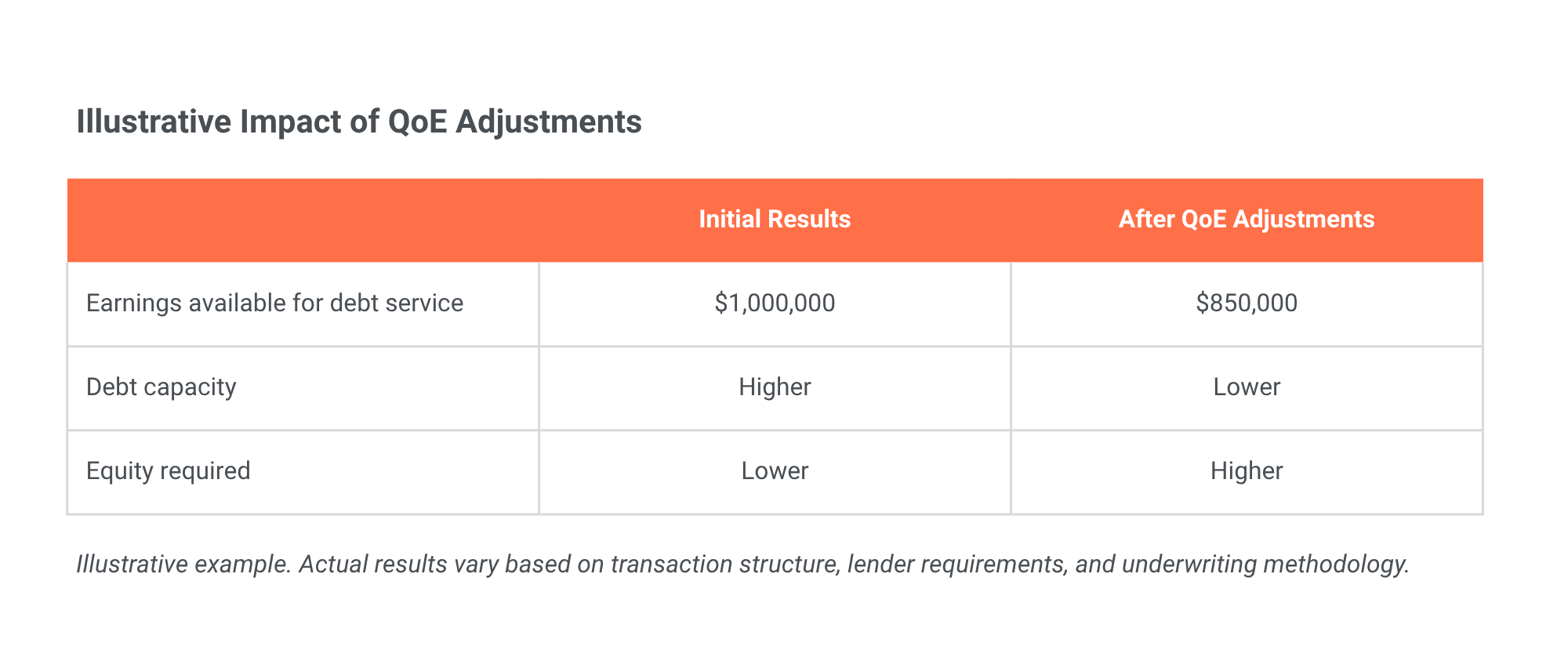
The new requirement provides lenders with an independent assessment of earnings before financing is finalized. Rather than relying solely on reported financial results, lenders will have additional support for the earnings used in the underwriting process.
The objective is to improve confidence that financing decisions are based on earnings that are sustainable, supportable, and properly documented.
How the Requirement May Affect Transactions
The additional diligence requirement may influence transaction timelines, borrower expectations, and deal structure. Buyers, sellers, and lenders should anticipate:
- Additional time to complete the QoE review
- Additional transaction costs
- Increased scrutiny of seller-provided earnings adjustments
- Potential reductions in normalized earnings due to unsupported add-backs
- Revisions to debt service coverage calculations
- Increased borrower equity requirements when sustainable earnings are lower than initially presented
- Earlier involvement of accounting and due diligence professionals
In many lower middle-market transactions, seller earnings calculations include adjustments for discretionary expenses, owner compensation, one-time costs, and other proposed add-backs. While many of these adjustments may be reasonable, a QoE review helps determine whether they are adequately supported and appropriate for underwriting purposes.
Quality of Earnings vs. Business Valuation
A QoE analysis and a business valuation serve different purposes. While a business valuation estimates the value of a business or ownership interest, a QoE analysis evaluates the quality and sustainability of the earnings being used in the transaction. It examines whether reported earnings are adequately supported and whether they appear sustainable after the transaction closes.
The two analyses complement one another. A valuation estimates value, while a QoE helps validate the earnings that support both that value and the proposed financing structure.
What a QoE Analysis Includes
The SBA outlines several areas that a Quality of Earnings review must address, including:
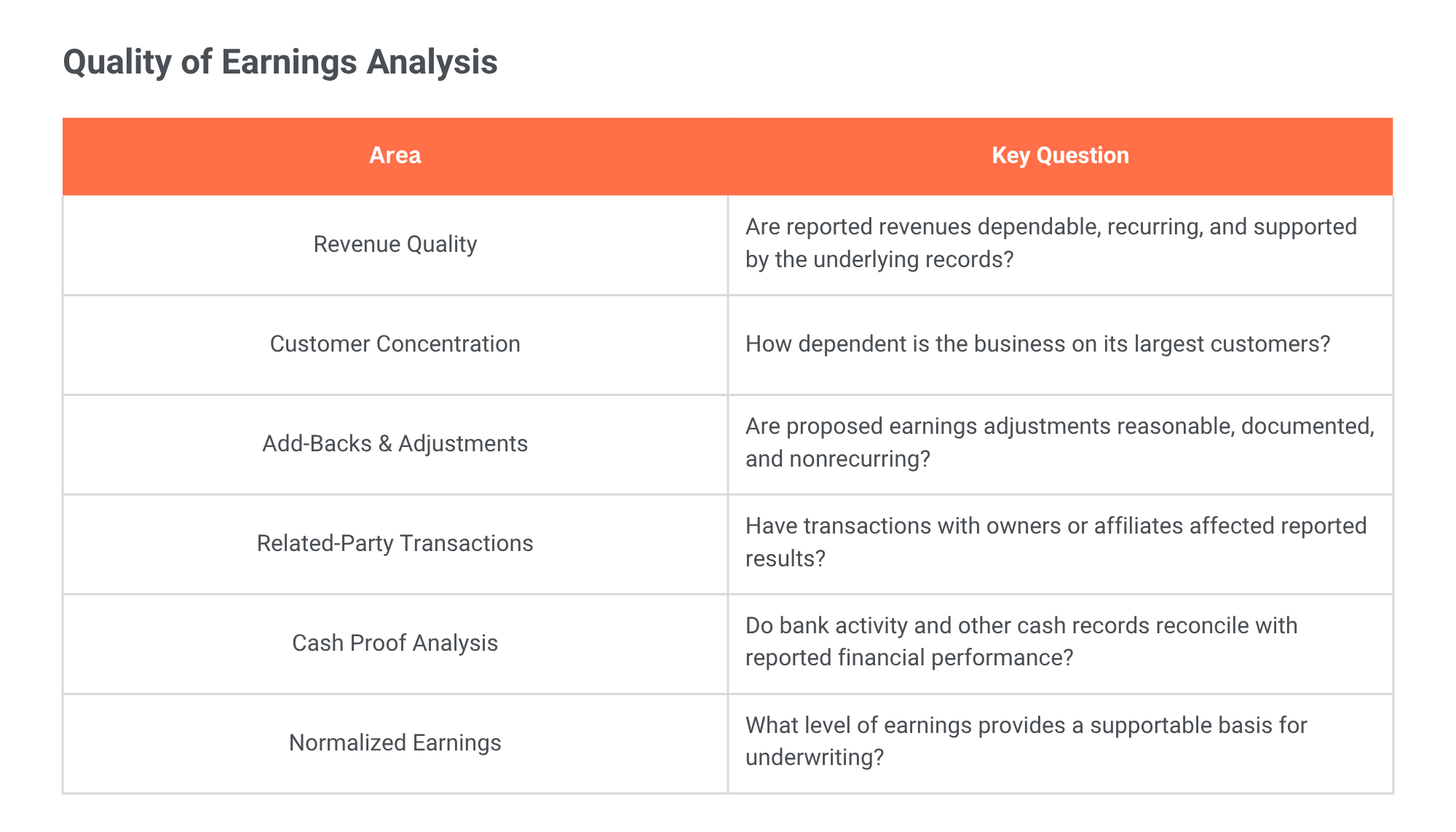
One of the more notable requirements is the cash proof analysis, which examines both the trailing 12-month period and the two most recent fiscal years. By reconciling reported activity to bank records and cash flows, lenders gain additional support that reported revenue and expenses are reflected in actual operating activity rather than solely in accounting records.
It is also worth noting that SBA guidance requires the QoE to be performed by an independent qualified provider and obtained by the lender as part of its underwriting process. While buy-side and sell-side QoE analyses may continue to play an important role in transactions, the SBA requirement is specifically intended to support the lender’s underwriting process.
Looking Ahead
For lenders, the new requirement provides an additional layer of support for the earnings used in underwriting acquisition loans. For buyers and sellers, it reinforces the importance of maintaining accurate financial records and ensuring that proposed earnings adjustments can be supported with appropriate documentation.
As implementation approaches, transaction participants who prepare for the QoE process early will be better positioned to avoid surprises during underwriting and closing. While the requirement adds another step to the acquisition process, it is intended to improve transparency, strengthen underwriting decisions, and enhance confidence in the financial performance supporting SBA-financed transactions. If you would like assistance preparing your team for this change or have questions on the requirements, contact us today.
Meet the Expert
September 23, 2026
Please note: Operational and regulatory guidance is frequently changing and the information included here may be out of date—please consult the latest guidance and with your advisor before taking action.
Reach out to our team
Let's discuss
Interested in discussing this topic further? Fill out this form to get in touch with our advisors and get the conversation started. Together, we can help light the path forward to a brighter future.